

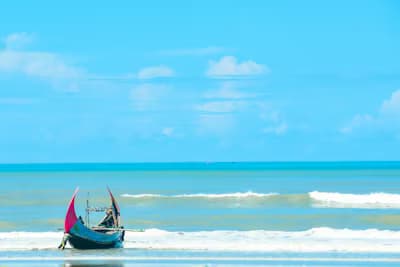
Discover the world's longest sea beach and experience the stunning sunset views in Cox's Bazar.
Nestled between emerald hills and the shimmering Bay of Bengal, this destination has long captured the imagination of seasoned wanderers and first-time explorers alike. Every corner reveals a new story — from the ancient fishing villages draped in morning mist to the sun-drenched promenades lined with swaying coconut palms. This is not merely a place on a map; it is a living, breathing canvas painted by tides, time, and the resilient spirit of its people.

The endless shoreline — stretching over 120 kilometres of unbroken natural beach.
The Coast at Dawn
Arriving before sunrise, you witness the beach in its most sacred state. Fishing boats slip silently back to shore, their hulls painted rust-red and cobalt blue, nets heavy with the night's catch. The sky transitions through a dozen shades — amber, rose, pale violet — before settling into the brilliant blue of a coastal morning. Local vendors set up cane chairs and bamboo tea stalls, and the smell of freshly fried fish mingles with salt air in a way that stays with you long after you leave.


Left: Traditional boats moored at dawn. Right: The quiet beach before the crowds arrive.
“There is something profoundly humbling about standing where land surrenders to sea — where the ordinary world dissolves into something vast and unhurried.”
— A Traveller's Journal
Where to Stay & Dine
The hospitality here has evolved considerably. Boutique resorts now sit alongside traditional guesthouses, offering everything from candlelit dinners by the water's edge to hammock-strung verandas overlooking private coves. The local cuisine is extraordinary — coconut-laced rice dishes, river prawn curries, and slow-grilled seafood served on palm-leaf platters. For those seeking refinement, several establishments offer curated tasting menus celebrating the region's coastal bounty with contemporary technique.

An evening meal by the water — a ritual that belongs to every visit.
Beyond the Beach
Venture inland and the landscape shifts dramatically. Dense mangrove forests shelter deer and river wildlife. Channels carve through the delta like silver threads, best explored by wooden rowboat at the hour before dusk when the light turns everything molten and unhurried.
The hill tracts to the east offer a different world entirely — indigenous communities with centuries-old weaving traditions, terracotta-roofed monasteries clinging to mist-covered ridges, and a quietude that modern travel rarely provides. Coming here demands slowness. It rewards patience.


Mangrove channels, riverside camps, and hill-trail vistas beyond the shore.
Practical Notes for the Traveller
The best time to visit runs November through March, when the monsoon has passed and the air carries a gentle coolness. Avoid peak festival weekends if solitude matters — the beach can host upwards of fifty thousand visitors on public holidays. Getting there is straightforward: an overnight bus or a short flight followed by a scenic coastal drive flanked by paddy fields and river crossings.
Wherever you go, move slowly. Let the tides set your schedule. The real reward is not a checked box on an itinerary — it is the particular quality of light at 5am, the smell of salt and jasmine all at once, and the realisation that some places still resist the flattening of everywhere.
2 Comments

August 10, 2023 — 10:30 AM
Interactively visualize top-line internal or "organic" sources rather than top-line niche mark unleash 24/7 opportunities after high standards in process improvements. Uniquely deploy methodologies with reliable information.
August 10, 2023 — 11:45 AM
Interactively visualize top-line internal or "organic" sources rather than top-line niche mark unleash 24/7 opportunities after high standards in process improvements. Uniquely deploy methodologies with reliable information.